NEWS & INSIGHTS

News

From professional insights to everyday joint care.
Explore Dr. Chen Jiun Liang’s media coverage and joint health information.

In the NewsJoint Health
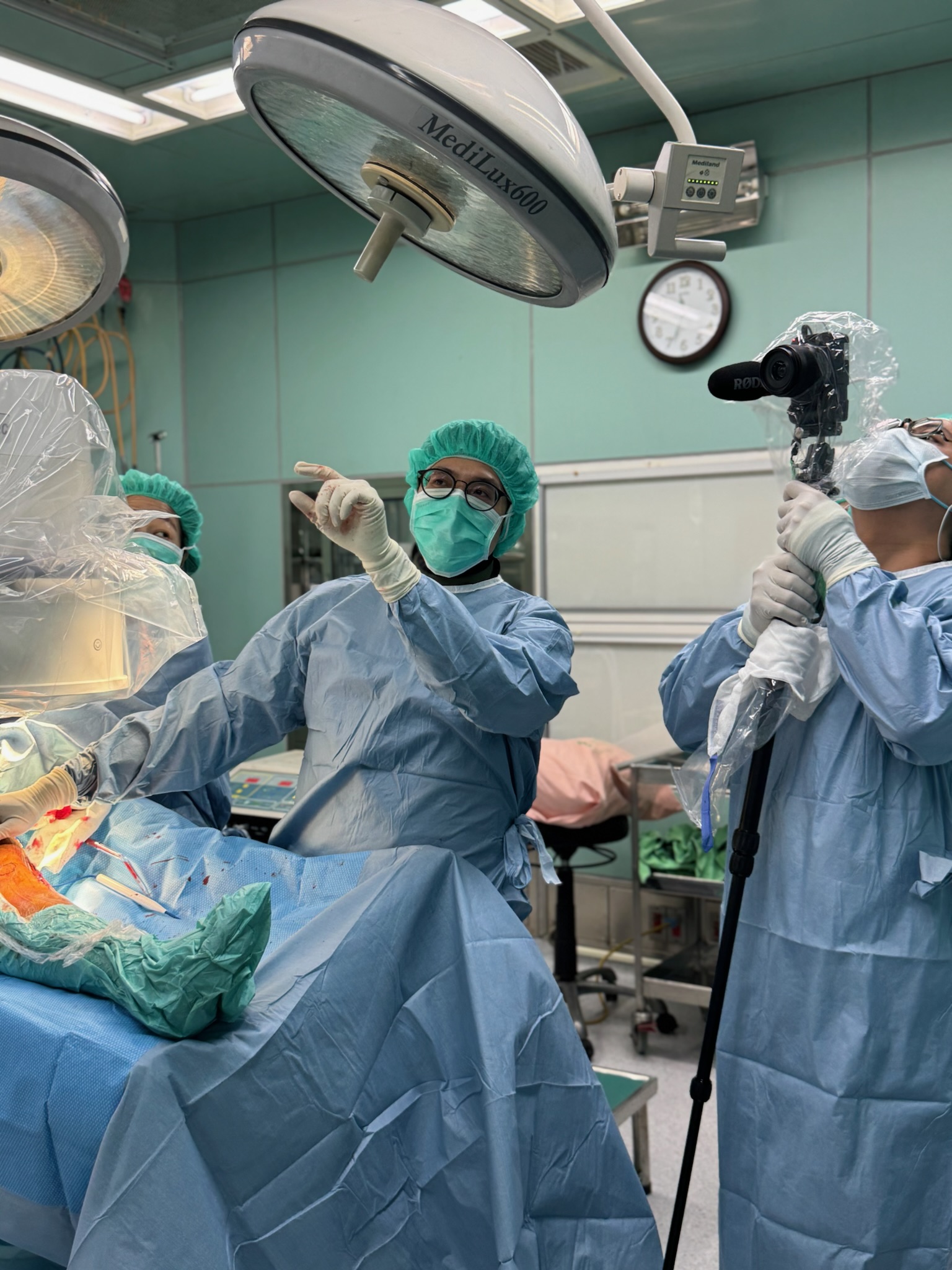
陳俊良醫師於手術室進行手術,團隊在旁記錄現場
INSIDE THE OR · JOINT HEALTH

影片專區

手術室現場、工具介紹、關節短片與手術衛教。
影片籌備中,先探索你感興趣的主題。

探索影片專區 →
INSIDE THE OR · JOINT HEALTH

Video Library

Inside the operating room, instruments, shorts and surgery education.
Videos are in preparation. Explore the topics.

Explore the video library →

News & Articles

Doctor updates · Treatment insights · Everyday care

News categories
2026.10.24
換髖關節前,先了解長短腳原因。以三張示意圖認識 DAA 如何協助控制術後腿長差異,並兼顧關節穩定與復原照護。
← Back to patient education

HIP · LEG LENGTH · JOINT HEALTH JOURNAL

Unequal legs after hip replacement? How DAA helps manage leg length

Concern about unequal legs is understandable when planning a hip replacement. A difference may already exist before surgery. The direct anterior approach (DAA) can facilitate intraoperative comparison and measurement, but cannot guarantee perfectly equal leg lengths.

First identify where the difference comes from

Unequal legs may relate to development, an old fracture or joint disease. Pelvic tilt or joint contracture can also create an apparent difference. Assessment combines posture, gait, examination and, when needed, standing full-length X-rays.

ILLUSTRATION 01

Different sources of unequal leg length

Concept only: structural and positional factors may coexist. Appearance alone is not a diagnosis.

How can DAA help control leg length?

DAA is usually performed with the patient lying on their back, allowing leg comparison and optional imaging. Planning and measurements help manage length. A 2024 review found fewer differences over 1 cm in DAA comparison studies, but mostly low-level evidence does not establish a guarantee.

ILLUSTRATION 02

Three parts of leg-length planning

The diagram does not imply identical equipment for every patient. Methods depend on the surgical plan.

Leg length and hip stability both matter

Hip replacement must restore function and stability as well as length. Surgeons balance these goals and soft-tissue tension. If one leg feels longer afterwards, report it at follow-up. Examination guides observation, rehabilitation or consideration of a shoe lift. DAA does not treat every cause of unequal legs.

ILLUSTRATION 03

Plan for overall function

Reconstruction and walking function are individualized; a single length measurement is not the only goal.

Frequently asked questions

Who assesses unequal leg lengths?

An orthopaedic clinician can assess leg length, the pelvis and joints. For concerns after hip replacement, start with your operating surgeon.

Does DAA guarantee equal legs?

No. Positioning and measurement can help control discrepancy, but anatomy, planning and stability requirements still matter.

Care includes soft-tissue preservation when appropriate and support through recovery. Bring previous imaging and describe when the difference began and which activities are uncomfortable.

General education does not replace individual assessment. Diagrams illustrate concepts, not a diagnosis or guaranteed result.
2026.10.21
Learn when hip or knee symptoms warrant a surgical discussion, when nonsurgical care is reasonable, and why disease stage matters.
← Back to patient education

Care decisions · JOINT HEALTH JOURNAL

When Is Joint Surgery Needed? Timing Hip and Knee Treatment

Not every painful joint needs an operation, and you do not need to wait until walking is impossible to seek care. The decision combines the pain source, impact on daily life, previous treatment and disease stage, alongside your goals and the expected benefits and risks.

01Consider symptoms and daily life, not X-rays alone
02Discuss options when appropriate nonsurgical care is insufficient
03Joint-preserving options depend on disease stage

When nonsurgical care remains reasonable

If symptoms are manageable, function is acceptable and no urgent problem is present, discuss tailored exercise, activity changes, weight management where appropriate, and medicines or other treatments suited to the diagnosis. Confirm the pain source and review whether treatment is helping.

ILLUSTRATION 01

Assess, treat and reassess

An individualized pathway; not everyone needs to try every available treatment.

When pain keeps limiting your life

A surgical discussion is reasonable when persistent symptoms interfere with walking, stairs, dressing, work or sleep despite appropriate nonsurgical care. Examination and imaging should support the diagnosis, and overall health and anesthetic risks need assessment. The aim is meaningful relief of pain and disability, not simply a better-looking X-ray; age alone is not the decision.

ILLUSTRATION 02

Bring daily-life examples

Discussion prompts, not a score that determines whether surgery is necessary.

Different conditions have different treatment windows

Medial knee arthritis with a correctable bowlegged alignment may allow assessment for HTO. Hip osteonecrosis before collapse may allow hip-preserving options. Advanced wear or collapse can shift the discussion toward replacement. Earlier assessment helps identify options; it does not automatically mean immediate surgery.

ILLUSTRATION 03

Stage changes the discussion

Stage, extent of damage and individual suitability require clinical assessment.

Three questions for your appointment

  • Is this joint definitely the source of my pain?
  • What are the trade-offs of treatment now versus observation?
  • Am I a candidate for preservation or replacement?

Good timing is a shared decision based on the condition, daily needs and safety. From tissue-preserving options to follow-up and rehabilitation, the goal is a supported return to everyday life.

Medical references

General education does not replace individual assessment. Treatment is tailored to your condition and goals; diagrams illustrate concepts.

2026.10.21
Compare partial and total knee replacement, implant components, ligament-related designs and fixation. Prepare questions about suitability and cost.
← Back to patient education

Knee health · JOINT HEALTH JOURNAL

Choosing a Knee Implant: Arthritis Pattern, Ligaments and Design

First decide how much of the knee needs resurfacing; then discuss the implant design. Arthritis distribution, ligament function, bone quality and everyday goals are more useful than a brand, price or “high-flexion” label alone.

01Aim for less joint pain and better everyday function
02Match partial or total replacement to the damage
03Match design and fixation to ligaments and bone

Partial versus total describes the treated area

Partial replacement addresses a limited compartment and requires suitable remaining joint surfaces and ligaments. More widespread damage may call for total replacement. This is a treatment-scope decision, not simply an implant upgrade. HTO is a different option that preserves surfaces by changing alignment.

ILLUSTRATION 01

Start with the treatment scope

Each option has selection criteria; pain location alone is not enough.

What makes up a knee implant?

Typical components include a femoral surface, tibial tray and polyethylene insert. Patellar resurfacing is considered separately. Bearing materials and insert design matter, but a special material does not guarantee a better result for everyone. Tell your surgeon about metal allergy or previous implant problems.

ILLUSTRATION 02

Main knee implant components

123
01Femoral component02Polyethylene insert03Tibial tray04Patella assessed separately
Simplified components; actual shape, size and material vary by system.

Ligaments, fixation and evidence guide design

CR designs retain the posterior cruciate ligament; PS designs substitute for part of its stabilizing role. Neither name alone establishes superiority. Bone quality also informs cemented or cementless fixation. Ask why a design is recommended, what follow-up evidence supports it, and how coverage and costs apply. Robotic assistance is a surgical tool, not an implant grade.

ILLUSTRATION 03

Four implant-selection checkpoints

Discuss your needs, the surgeon’s experience and device evidence together.

Three questions for your appointment

  • Why is partial or total replacement suitable for me?
  • How do my ligaments and bone influence design?
  • What are the evidence, covered alternatives and personal cost?

The goal is pain relief and useful everyday function. Implant selection works together with planning, soft-tissue balance and rehabilitation—not a product name alone.

Medical references

General education does not replace individual assessment. Treatment is tailored to your condition and goals; diagrams illustrate concepts.

2026.10.21
Understand hip implant components, ceramic and polyethylene bearings, fixation options and the questions to ask about evidence and cost.
← Back to patient education

Hip health · JOINT HEALTH JOURNAL

Choosing a Hip Implant: Materials, Fixation and Your Needs

Separate the bearing surface, fixation method and your individual needs. A higher price or newer name does not automatically mean a better match. Bone quality, anatomy, activity and stability risks all belong in the discussion.

01Separate bearing choice from fixation
02Consider wear performance alongside clinical evidence
03Confirm suitability, covered alternatives and total cost

Know the components before comparing materials

A total hip usually includes a cup, liner, head and stem. The head moves against the liner: this is the bearing surface. How the cup and stem attach to bone is a separate question. “Ceramic hip” does not mean every component is ceramic.

ILLUSTRATION 01

Four components, different roles

1234
01Cup02Liner03Head04Stem
A component concept diagram, not the shape of a particular brand or model.

Compare bearing surfaces and trade-offs

Common combinations pair a metal or ceramic head with polyethylene; highly cross-linked polyethylene is designed to reduce wear. Ceramic-on-ceramic also offers low wear, with trade-offs including noise and rare fracture. These differences inform a shared decision, not a price ranking or lifespan guarantee. Metal components do not automatically mean a metal-on-metal bearing.

ILLUSTRATION 02

Compare head-and-liner pairs

Each pairing has trade-offs. Availability and suitability depend on the system and patient.

Match fixation and clarify the total cost

Cemented fixation uses bone cement; cementless fixation relies on initial stability followed by bone ingrowth. Bone quality and anatomy influence selection. Ask for covered alternatives, the exact product and code, how coverage applies, and your total out-of-pocket cost rather than comparing one component’s price alone.

ILLUSTRATION 03

Three questions for a shared decision

Confirm suitability with your surgeon and itemized costs with the hospital.

Three questions for your appointment

  • Which head and liner are proposed?
  • Why does this fixation suit my bone?
  • What specific difference does the additional cost buy?

DAA describes the surgical approach; implant selection describes the reconstruction. They are different decisions. Bring your activity goals, allergy history and budget to the consultation.

Medical references

General education does not replace individual assessment. Treatment is tailored to your condition and goals; diagrams illustrate concepts.

2026.10.21
Understand medial opening-wedge high tibial osteotomy, plate fixation, patient selection and the trade-offs of preserving your own knee.
← Back to patient education

Knee health · JOINT HEALTH JOURNAL

HTO Knee Preservation: Realigning the Leg to Unload Arthritis

With inner-knee arthritis and a bowlegged alignment, load may remain concentrated on the worn compartment. High tibial osteotomy (HTO) changes leg alignment to transfer load toward a healthier area, offering a knee-preserving option for selected patients.

01Preserves native knee surfaces
02Realigns a bowlegged limb to unload the inner knee
03May postpone replacement in suitable patients

Selection starts with the pattern of arthritis

Assessment often focuses on active patients with predominantly medial arthritis and a correctable varus alignment. The other compartments, ligament stability, motion and bone quality also matter. Extensive arthritis across several compartments may make another treatment more appropriate.

ILLUSTRATION 01

Redistributing joint load

Redistributing joint load
Conceptual load lines; correction is planned using standing imaging and clinical assessment.

Opening-wedge osteotomy and plate fixation

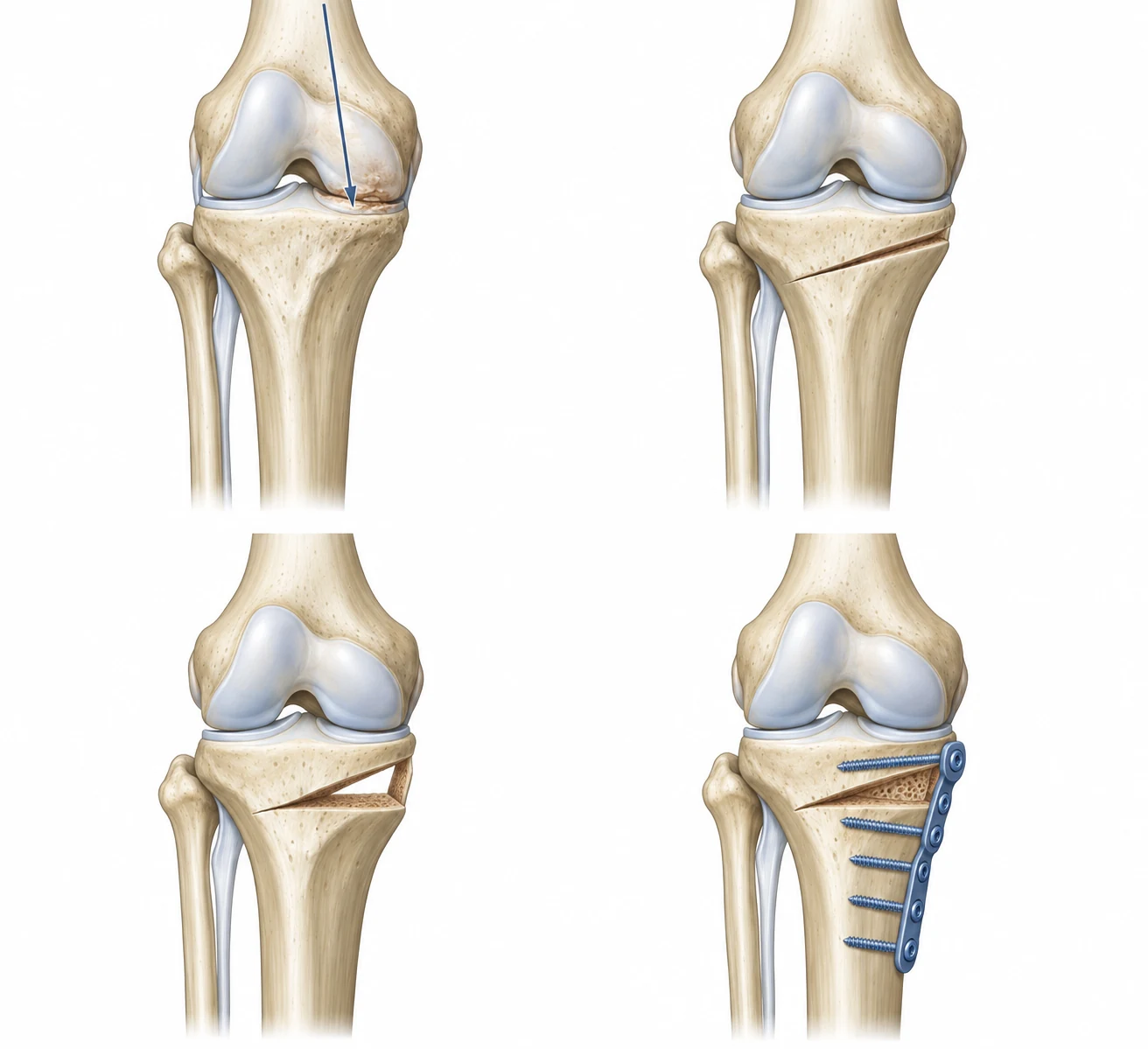
A planned cut is made in the upper tibia, opened from the medial side to adjust alignment, and held with a plate and screws while bone heals. The native knee surfaces remain. Dr. Chen’s usual planning estimate is about one hour, adjusted for correction and any additional procedures; anesthesia preparation and recovery-room time are separate.

ILLUSTRATION 02

The HTO treatment pathway

Conceptual overview of correction and fixation; details are individualized.

Preservation comes with a healing commitment

HTO preserves the native joint and may postpone replacement. Higher-impact activity depends on bone healing, strength and reassessment. Discuss risks such as delayed healing, infection, clots, incomplete correction and plate irritation. It does not guarantee that joint replacement will never be needed.

ILLUSTRATION 03

Preservation and replacement work differently

Wear distribution and ligament function matter; age alone does not decide.

Three questions for your appointment

  • Is my arthritis mainly in the medial compartment?
  • How do HTO, partial and total replacement fit my condition?
  • How will healing and readiness for activity be assessed?

The aim is less pain and better function with your native knee. Dr. Chen emphasizes tissue preservation and ongoing support, adapting rehabilitation to your follow-up findings.

Medical references

General education does not replace individual assessment. Treatment is tailored to your condition and goals; diagrams illustrate concepts.

2026.10.21
Learn how direct anterior hip replacement uses muscle planes, how capsule repair is considered, and which questions to discuss with your surgeon.
← Back to patient education

Hip health · JOINT HEALTH JOURNAL

What Is DAA Hip Replacement? A Muscle-Sparing Approach

Direct anterior approach (DAA) hip replacement reaches the joint from the front, replacing damaged surfaces to relieve pain and support everyday movement. It uses a plane between muscles with an emphasis on soft-tissue preservation. New York’s Hospital for Special Surgery (HSS) describes anterior replacement as widely adopted in the United States; suitability remains an individual decision.

01Uses muscle planes to limit major muscle and tendon disruption
02May support earlier functional improvement in selected patients
03Reconstructs the joint to relieve pain and support daily life

Muscle planes and capsule repair

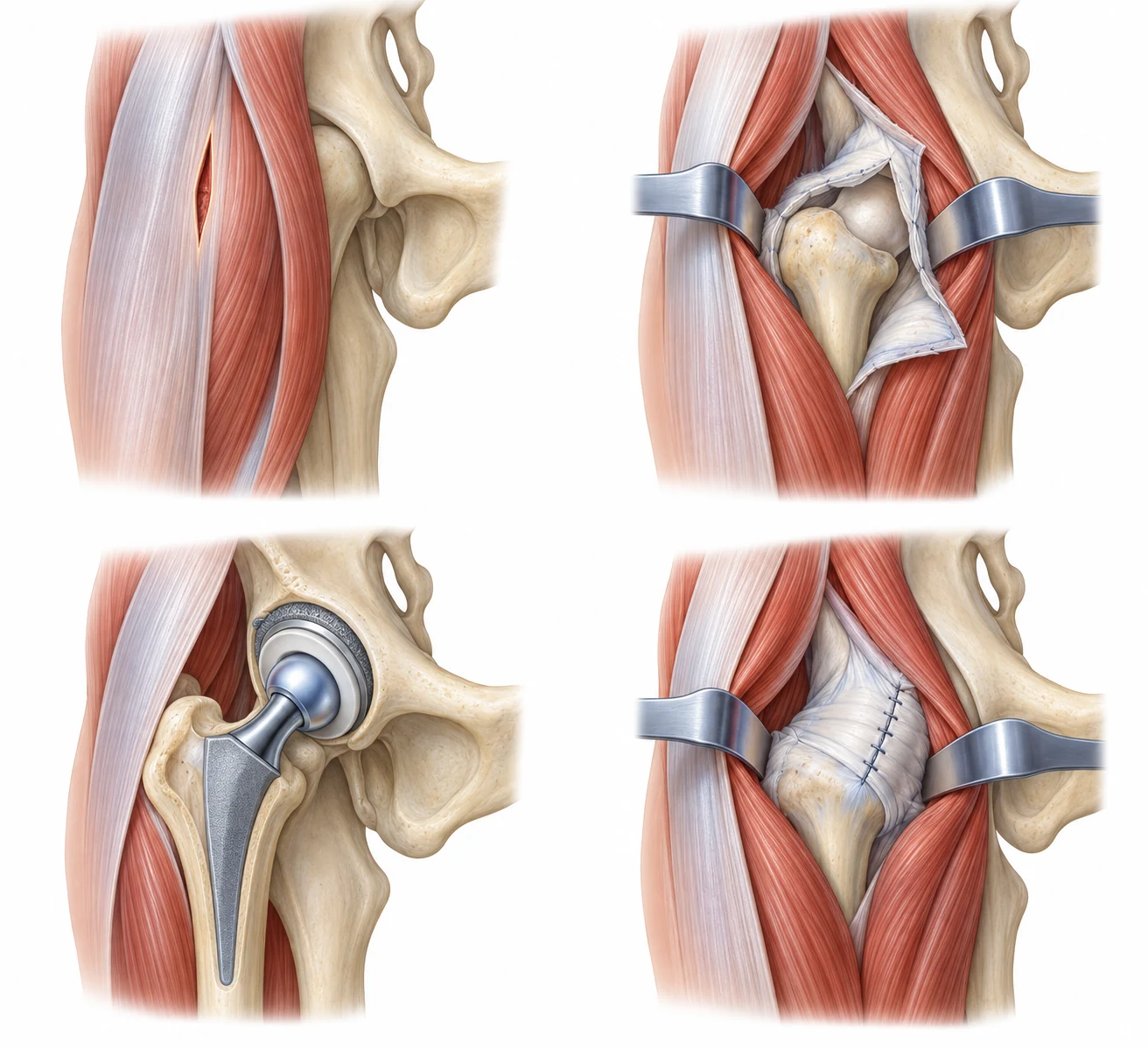
DAA uses an interval between muscles rather than routinely detaching major muscles to gain access. Dr. Chen also emphasizes preserving capsule tissue: it is opened for access and repaired when the tissue and operative circumstances allow. Tissue preservation does not mean that no tissue is opened or that surgery is risk-free.

ILLUSTRATION 01

From muscle interval to joint

From muscle interval to joint
Conceptual access and tissue-handling sequence; the actual technique is individualized.

Replacement includes alignment and stability

The damaged femoral head and joint surfaces are replaced with socket and femoral components. Stability, movement and leg length are checked. Dr. Chen’s usual planning estimate is about 1.5–2 hours of surgery; complexity can change this, and anesthesia preparation and recovery-room time are separate.

ILLUSTRATION 02

Four parts of the procedure

A patient-oriented overview, not an operative instruction.

How does it compare with other approaches?

The main differences are access direction and soft-tissue handling. DAA may offer early functional advantages for selected patients, but is not proven best for everyone over the long term. Lateral and posterior approaches remain established options. Discuss infection, dislocation and fracture, as well as possible skin-sensation changes associated with anterior access.

ILLUSTRATION 03

Choose an approach in context

The approach name alone does not determine outcomes or implant choice.

Three questions for your appointment

  • Is DAA appropriate for my anatomy?
  • How will capsule repair and implant choice be planned?
  • How will follow-up and rehabilitation be coordinated?

Care extends from tissue preservation to wound, strength and gait follow-up. Plan work, sport and travel with your team according to your individual progress.

Medical references

General education does not replace individual assessment. Treatment is tailored to your condition and goals; diagrams illustrate concepts.

2026.10.20
Hip osteonecrosis does not always mean immediate replacement. Learn how collapse, lesion size and imaging guide hip-preserving and replacement options.
← Back to patient education

Hip health · JOINT HEALTH JOURNAL

Hip Osteonecrosis in Younger Adults: Preserve or Replace?

Osteonecrosis, also called avascular necrosis or AVN, occurs when bone loses an adequate blood supply. It can affect younger adults too. The choice of treatment depends on the extent of damage, whether the femoral head has collapsed and its effect on daily life—not age or walking ability alone.

Symptoms can be less obvious than expected

Early disease may have few symptoms. Later, discomfort can occur in the groin or buttock and become more noticeable with weight bearing. Injury, some medicines and medical conditions may be relevant, although a cause is not always clear. Share any corticosteroid history; do not stop prescribed treatment on your own.

ILLUSTRATION 1

Why blood supply matters

Concept only. Progression and its pace vary; this is not a prediction for every patient.

Imaging helps define the stage and extent

X-rays show bone shape and joint changes. If early osteonecrosis is suspected despite an unrevealing X-ray, MRI may provide more information. The assessment looks at location, size and collapse as well as diagnosis, helping clarify whether preserving the natural hip remains an option.

ILLUSTRATION 2

Imaging provides complementary information

MRI is selected when clinically useful, not automatically for everyone.

Preservation or replacement depends on the findings

Selected patients before collapse may be considered for core decompression, sometimes with bone grafting. Preservation cannot guarantee that the disease will stop progressing. When collapse and joint damage significantly affect life, total hip replacement may be discussed. Both pathways require follow-up and individual activity advice.

ILLUSTRATION 3

Stage the disease, then discuss options

These are discussion pathways, not automatic treatment rules based on one finding.

Ask: “Has the femoral head collapsed? Am I a candidate for preservation? How would we monitor it?” Discussing imaging alongside your life goals is more useful than age alone.

Medical references

General education does not replace an individual assessment. Treatment is tailored to your condition and goals. Diagrams explain concepts, not an individual diagnosis.

2026.10.20
Explore knee osteoarthritis treatments, from exercise and medicines to osteotomy, partial and total knee replacement, and how options are assessed.
← Back to patient education

Knee health · JOINT HEALTH JOURNAL

Does Knee Osteoarthritis Always Need a Knee Replacement?

Not always. Treatment depends on pain, daily limitations, examination findings and what has already been tried. X-rays matter, but are not the only consideration. The aim is to improve comfort and function while preserving the natural joint and surrounding tissues when appropriate.

Understand the role of nonsurgical care

A tailored plan may include strengthening, suitable low-impact activity, weight management when relevant and pain relief. Medicines or injections need to be considered alongside other conditions and risks. Symptom improvement does not mean cartilage has regrown, and protecting the knee does not usually mean stopping all movement.

ILLUSTRATION 1

Build a plan around daily needs

The combination is individual; not everyone needs the same prescription.

Surgery also involves different choices

High tibial osteotomy changes load distribution and may suit selected knees with malalignment and one-sided disease. Partial replacement treats a suitable, limited compartment; total replacement may address more extensive arthritis. Disease pattern, alignment and ligament function help guide the choice—not age alone.

ILLUSTRATION 2

Options are alternatives, not a fixed ladder

Conceptual comparison; each procedure has specific indications, limitations and risks.

Ask which option fits your goals

If appropriate treatment still leaves significant pain or daily limitations, discuss whether surgery could help. Explain which activities matter and what worries you. Ask about likely benefits, alternatives and follow-up rather than choosing by the novelty of a procedure’s name.

ILLUSTRATION 3

Three parts of the treatment decision

A decision combines information rather than relying on age or an X-ray alone.

Good care includes discussion before treatment and support through rehabilitation and follow-up. Joint preservation and replacement are assessed against your knee’s condition and your daily needs.

Medical references

General education does not replace an individual assessment. Treatment is tailored to your condition and goals. Diagrams explain concepts, not an individual diagnosis.

2026.10.20
If your parent is walking less, record changes in pain, daily tasks and mobility. Use this practical guide to prepare for an orthopaedic appointment.
← Back to patient education

Family guides · JOINT HEALTH JOURNAL

Is Your Parent Walking Less? What to Record Before a Visit

Perhaps your parent used to walk to the market but now often needs a break. That change is worth noting. Slower walking can relate to joints, strength, balance or other health concerns. It should not automatically be dismissed as age—or assumed to require a joint replacement.

Compare everyday activities, not other people

Note how far they manage on a familiar route, whether they stop, and whether stairs, standing up, shoes or bathing now require help. Compare with their usual ability. Do not push them through pain to test a limit or meet a step target.

ILLUSTRATION 1

Track a change in the same everyday task

Choose shopping, stairs or shoes. There is no fixed ‘normal’ distance or speed in this example.

Bring symptoms and medical information together

Record the painful area, when it began, activities that worsen it, sleep disruption and any falls. Bring a medicine list, previous surgery details and available images, plus glasses or hearing aids. Prioritise two or three concerns rather than trying to cover everything at once.

ILLUSTRATION 2

Four notes to prepare before the visit

Use paper or a phone note. Incomplete records should not delay an appointment.

Support your parent’s voice in the consultation

Let your parent explain what matters most, then add your observations with their agreement. Goals such as shopping independently or sleeping more comfortably help make the discussion personal. If a fall leaves them unable to stand or bear weight, seek urgent assessment rather than waiting to finish a checklist.

ILLUSTRATION 3

Keep the patient’s goals at the centre

Family can help with understanding and notes while respecting the patient’s preferences.

The first visit aims to understand what has changed and plan the next step. Check the appointment information and bring the everyday examples you have recorded.

Medical references

General education does not replace an individual assessment. Treatment is tailored to your condition and goals. Diagrams explain concepts, not an individual diagnosis.