
DIRECT ANTERIOR APPROACH
Direct Anterior Total Hip Replacement
Rebuilding your joint through a natural muscle interval, with respect for your own tissue.
When might this be considered?
Hip arthritis or other joint disease limits walking and everyday activities.
Medication, rehabilitation or other options have not provided sufficient improvement after assessment.
Your surgeon reviews bone anatomy, previous surgery and overall health.
How is the surgery performed?
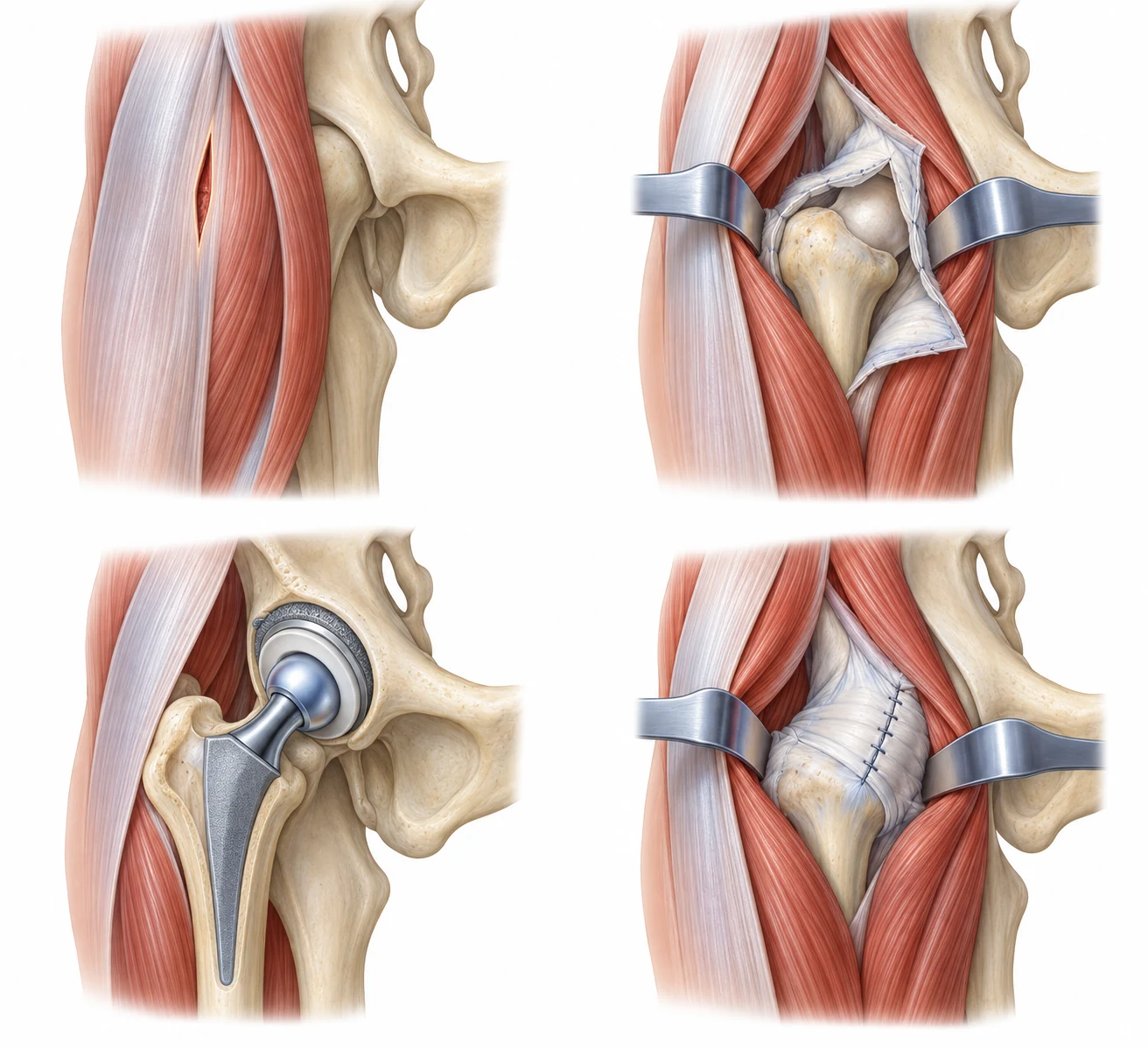
Approach from the front
A pathway is created at the front of the hip, avoiding major muscle attachment sites.
Work between the muscles
Tissues are separated along a natural muscle interval. The joint capsule is preserved, opened to access the joint, and later repaired.
Place the artificial joint
Damaged joint surfaces are prepared, and an acetabular cup, femoral stem and head are placed according to your bone anatomy.
Repair and check stability
The capsule is sutured and repaired. Joint stability is checked before the wound is closed.
AI-assisted illustrations show a simplified surgical sequence, not actual surgery. Procedures, instruments and implants vary with each patient’s condition.
The intermuscular approach reduces disturbance to major muscle attachments. The capsule is opened and then sutured for repair.
Activity and rehabilitation are adjusted according to wound healing, strength and walking pattern.
WATCH & UNDERSTAND
Patient education video
Direct anterior hip replacement (DAA)
You can read the illustrated guide above while the video is being prepared.
Explore the video library →Patient education video coming here soon.
How does DAA compare with lateral and posterior approaches?
| Approach | How the joint is accessed | Factors to consider |
|---|---|---|
| Direct anterior (DAA) | Through a muscle interval at the front of the hip. | Bone anatomy, surgical history and surgeon experience. |
| Lateral approach | From the side; some techniques involve the hip abductor muscles. | Soft-tissue handling varies with the specific technique. |
| Posterior approach | From the back, commonly involving release and repair of some short external rotators and the capsule. | Tissue-preserving variations are also available. |
Every approach has benefits and limitations. DAA is not free of tissue injury and is not suitable for everyone.
Ongoing support through recovery
- Wound and symptom careGuidance on wound monitoring, medicines and when to contact your medical team.
- Activity matched to your progressActivity and rehabilitation are adjusted according to wound healing, strength and walking pattern.
- Follow-up and your next stepsCare and training are adjusted using examination results and your everyday goals.
Questions you may have
Does DAA mean no tissue is cut at all?
No. The skin and joint capsule still need to be opened. The key is working between muscles and repairing the capsule after the replacement.
What risks should I understand?
Risks include infection, blood clots, fracture, dislocation, leg-length difference and nerve symptoms. Your surgeon will explain the risks relevant to your situation.
Concerned about unequal legs after hip replacement?
DAA positioning supports comparison and measurement. Planning helps manage leg length, while individual anatomy and hip stability remain important. Perfect equality cannot be guaranteed.
Find the treatment that fits your needs
Bring your symptoms, imaging and everyday goals to discuss with Dr. Chen.
References
This page provides general patient education. Treatment, surgery time and care arrangements are determined through individual clinical assessment.