
REVISION HIP REPLACEMENT
Revision Hip Replacement
Identify the problem with the existing joint and rebuild the parts that need attention.
When might this be considered?
Such as loosening, wear, recurrent dislocation or a fracture around the implant.
The source of pain is assessed, including infection and other possible causes.
The extent depends on component fixation, bone quality and soft tissues.
How is the surgery performed?
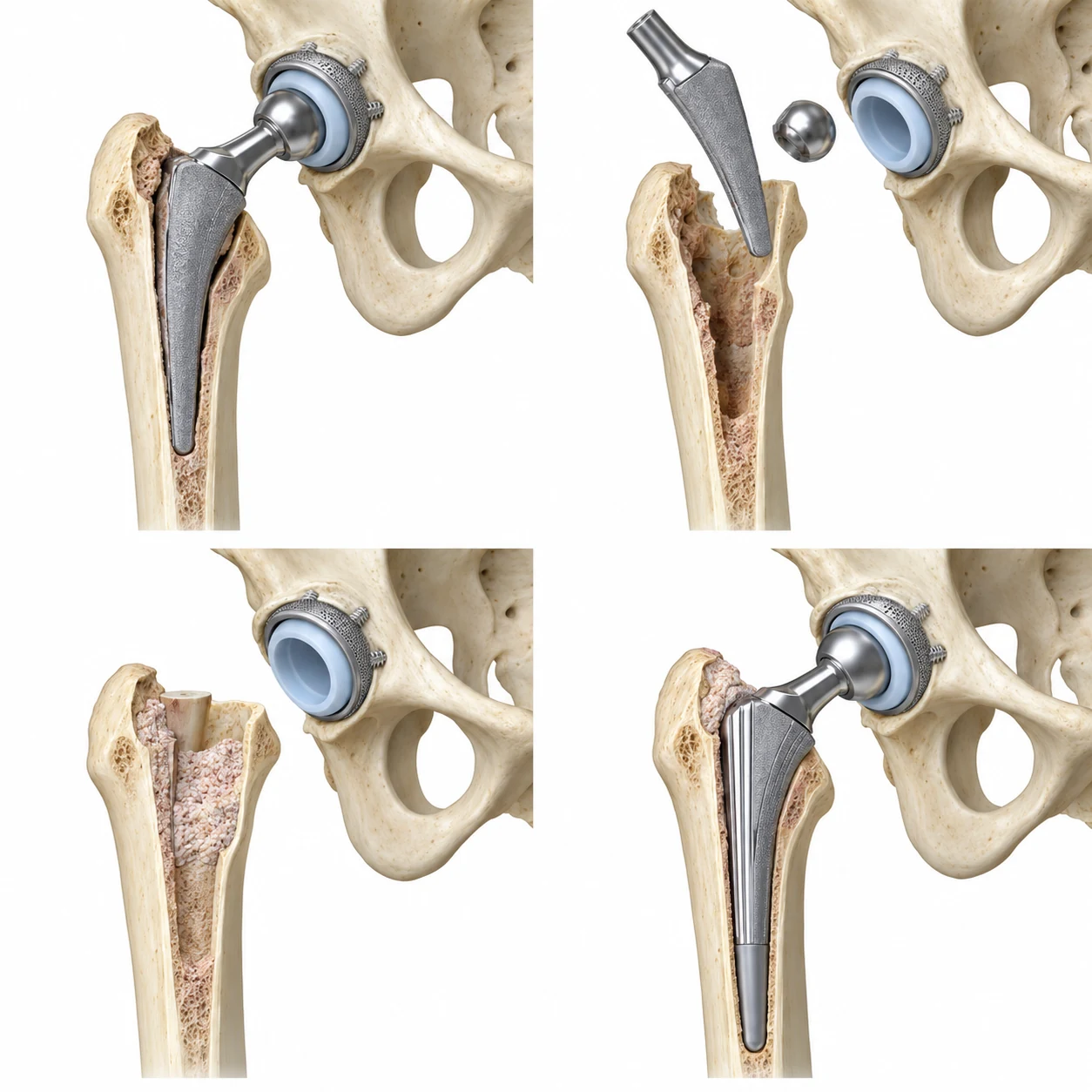
Identify what needs revision
The socket, femoral stem, head and surrounding bone are assessed to identify the problem.
Remove the necessary components
Affected components are removed while preserving as much usable bone as possible.
Address bone loss
Bone grafts or reconstruction components may be used to restore support.
Re-establish stability
Suitable components are placed and checked for fixation, position and stability.
AI-assisted illustrations show a simplified surgical sequence, not actual surgery. Procedures, instruments and implants vary with each patient’s condition.
Usable bone and soft tissues are preserved while the affected parts are reconstructed.
Fixation, wound healing and walking are monitored. Activity is planned according to the extent of reconstruction.
WATCH & UNDERSTAND
Patient education video
Revision hip replacement
You can read the illustrated guide above while the video is being prepared.
Explore the video library →Patient education video coming here soon.
How does revision differ from a first hip replacement?
| Aspect | Primary hip replacement | Revision Hip Replacement |
|---|---|---|
| What is treated | Damage to the native joint. | Problems with an existing artificial joint and surrounding tissues. |
| Reconstruction | Implants are selected according to bone anatomy. | May require removal of old components, bone grafts or specialized implants. |
| Treatment planning | Replacement is usually completed in one operation. | Infection and some other conditions may require staged treatment. |
Revision complexity varies widely. The time for a first replacement cannot simply be applied to revision surgery.
Ongoing support through recovery
- Wound and symptom careGuidance on wound monitoring, medicines and when to contact your medical team.
- Activity matched to your progressFixation, wound healing and walking are monitored. Activity is planned according to the extent of reconstruction.
- Follow-up and your next stepsCare and training are adjusted using examination results and your everyday goals.
Questions you may have
Does revision mean replacing every component?
Not always. It depends on fixation, infection and component compatibility. Sometimes only the affected parts need replacing.
Is revision for infection handled in the same way?
Not necessarily. Treatment may involve debridement, antibiotics or staged joint replacement, depending on the investigation results.
Find the treatment that fits your needs
Bring your symptoms, imaging and everyday goals to discuss with Dr. Chen.
This page provides general patient education. Treatment, surgery time and care arrangements are determined through individual clinical assessment.