
HIGH TIBIAL OSTEOTOMY
High Tibial Osteotomy (HTO)
Realign the leg, reduce pressure on the inner knee and preserve your own joint.
When might this be considered?
Weight passes mainly through the inner knee, contributing to pain and degeneration.
The outer and kneecap compartments, ligaments and range of motion need assessment.
You value preserving your own joint and can commit to monitoring bone healing.
How is the surgery performed?
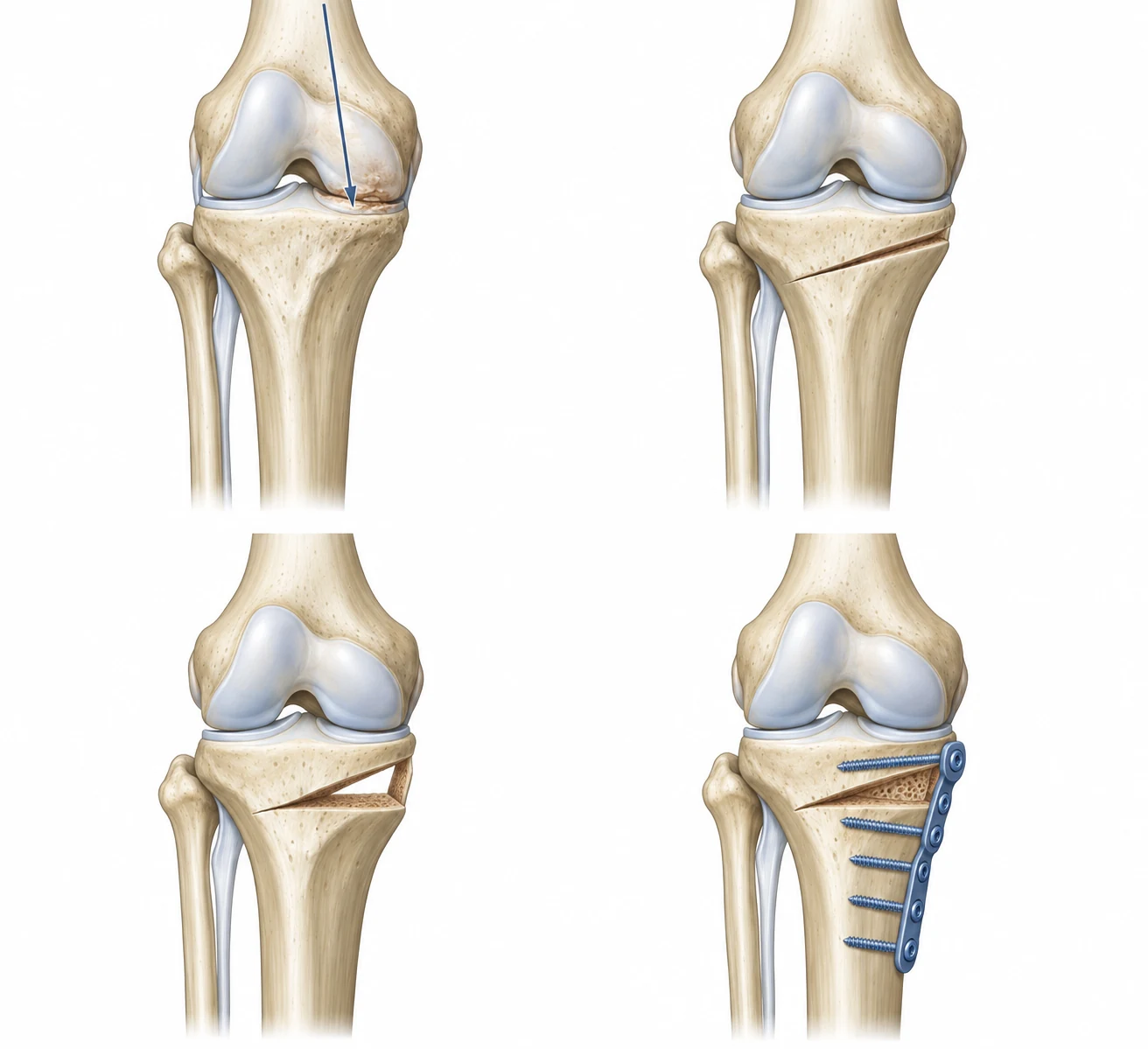
Plan the weight-bearing axis
Standing X-rays are used to calculate the required alignment correction.
Cut the inner upper tibia
An osteotomy is made on the inner side below the knee, retaining an outer bone hinge.
Open the wedge
The inner gap is opened to the planned angle to redistribute weight-bearing forces.
Secure with a plate and screws
The corrected position is held while the bone gradually heals.
AI-assisted illustrations show a simplified surgical sequence, not actual surgery. Procedures, instruments and implants vary with each patient’s condition.
The native joint surfaces are preserved. Realignment reduces inner-knee loading and may help delay joint replacement.
Bone healing and strength are monitored. Higher-impact activity requires follow-up assessment before it is resumed.
WATCH & UNDERSTAND
Patient education video
High tibial osteotomy (HTO)
You can read the illustrated guide above while the video is being prepared.
Explore the video library →Patient education video coming here soon.
HTO, partial or total knee replacement: how is the choice made?
| Treatment | Main approach | Assessment focus |
|---|---|---|
| HTO joint preservation | Realign the leg while preserving the native joint surfaces. | Inner-knee wear with bow-leg alignment; other compartments and activity needs are assessed. |
| Partial knee replacement | Replace one damaged compartment. | Wear is confined to one compartment and the remaining joint and ligaments are suitable. |
| Total knee replacement | Reconstruct more extensively damaged joint surfaces. | More widespread degeneration, pain or deformity affecting daily life. |
The choice depends on imaging, ligament stability, the distribution of wear and everyday needs. No single operation suits everyone.
Ongoing support through recovery
- Wound and symptom careGuidance on wound monitoring, medicines and when to contact your medical team.
- Activity matched to your progressBone healing and strength are monitored. Higher-impact activity requires follow-up assessment before it is resumed.
- Follow-up and your next stepsCare and training are adjusted using examination results and your everyday goals.
Questions you may have
What is the main benefit of HTO?
It preserves your own joint and shifts load away from the more worn inner compartment. In suitable patients, it can improve symptoms and help delay joint replacement.
Can I return to high-intensity activity?
Bone healing, strength and function must first be assessed. The decision is made through ongoing follow-up.
What are the risks and limitations?
Risks include delayed or failed bone healing, infection, nerve or blood-vessel injury, and under- or over-correction. Pain may persist, and replacement may still be needed later.
Find the treatment that fits your needs
Bring your symptoms, imaging and everyday goals to discuss with Dr. Chen.
References
This page provides general patient education. Treatment, surgery time and care arrangements are determined through individual clinical assessment.