
REVISION KNEE REPLACEMENT
Revision Knee Replacement
Understand the cause of pain or instability and rebuild support for your knee.
When might this be considered?
The components, bearing and surrounding bone are examined.
The cause is established before selecting a revision approach.
The plan depends on bone loss, ligament function and infection status.
How is the surgery performed?
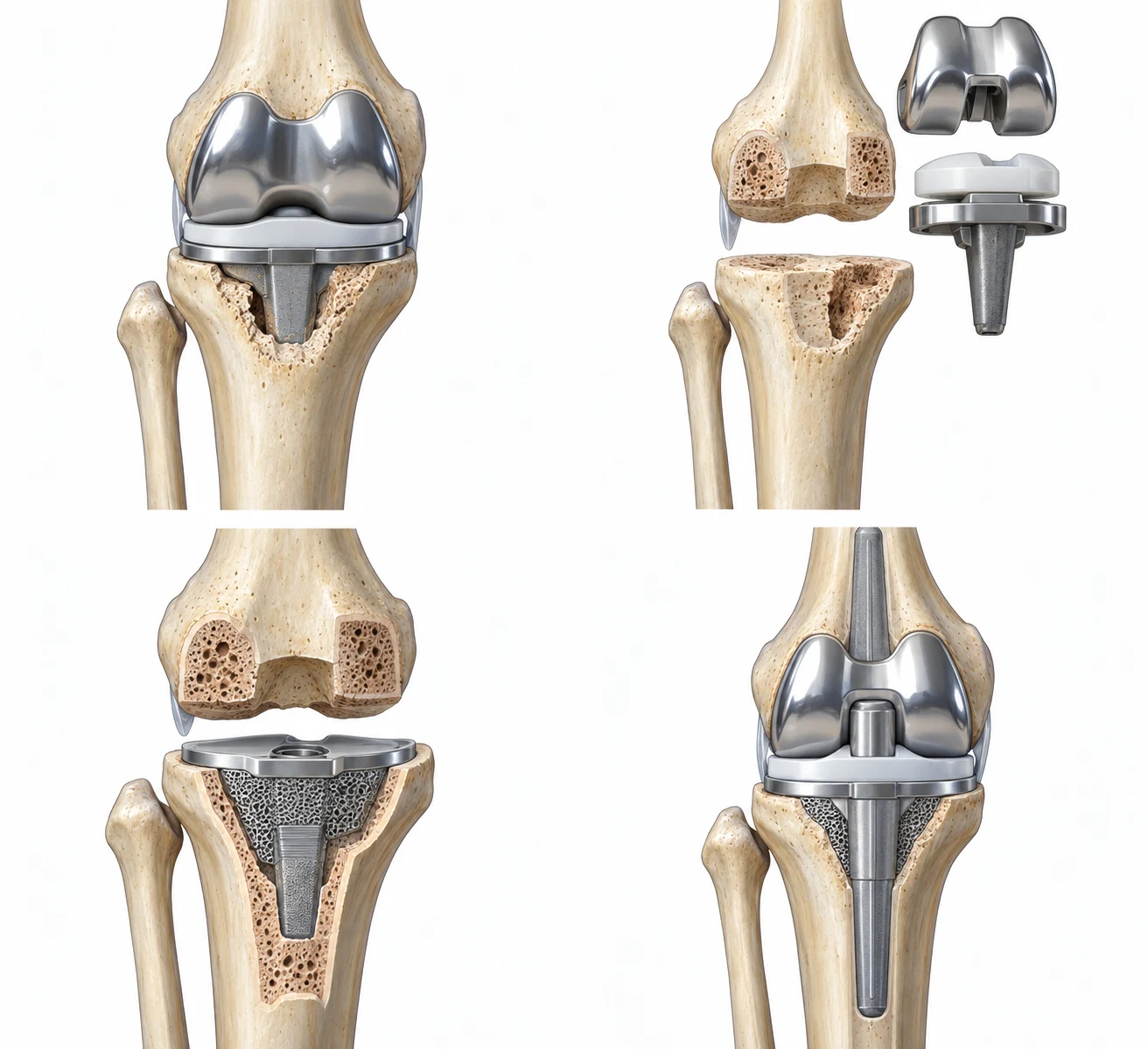
Find the source of the problem
Assessment considers loosening, wear, alignment, ligaments and infection.
Remove affected components
The necessary components are removed while protecting usable bone.
Reinforce bone support
Bone grafts, augments or other reconstruction components may be used according to the defect.
Restore balance and fixation
Appropriate revision components are chosen, then fixation, alignment and stability are checked.
AI-assisted illustrations show a simplified surgical sequence, not actual surgery. Procedures, instruments and implants vary with each patient’s condition.
Usable bone and soft tissues are preserved where possible. Implant stability is matched to ligament function.
Fixation, the wound and muscle strength are monitored. Exercises are adjusted to reconstruction and tissue condition.
WATCH & UNDERSTAND
Patient education video
Revision knee replacement
You can read the illustrated guide above while the video is being prepared.
Explore the video library →Patient education video coming here soon.
How does revision differ from a first hip replacement?
| Aspect | Primary total knee replacement | Revision Knee Replacement |
|---|---|---|
| What is treated | Wear and deformity of the native joint. | Problems with an existing artificial joint and surrounding tissues. |
| Implants | Selected according to existing bone and ligament condition. | May require longer stems, augments or a more stabilizing implant design. |
| Infection management | Relevant infection is excluded before surgery. | Infection may require debridement or staged treatment. |
Revision needs an individual plan. Operating time and reconstruction should not be assumed to match a first replacement.
Ongoing support through recovery
- Wound and symptom careGuidance on wound monitoring, medicines and when to contact your medical team.
- Activity matched to your progressFixation, the wound and muscle strength are monitored. Exercises are adjusted to reconstruction and tissue condition.
- Follow-up and your next stepsCare and training are adjusted using examination results and your everyday goals.
Questions you may have
Does revision always mean replacing everything?
No. Fixation, wear, compatibility and infection determine whether partial or complete revision is needed.
What additional considerations apply to revision?
Bone loss, ligament deficiency and infection increase complexity. Risks include recurrent infection, stiffness, loosening and persistent symptoms.
Find the treatment that fits your needs
Bring your symptoms, imaging and everyday goals to discuss with Dr. Chen.
This page provides general patient education. Treatment, surgery time and care arrangements are determined through individual clinical assessment.