
MINIMALLY INVASIVE TOTAL KNEE REPLACEMENT
Minimally Invasive Total Knee Replacement
Relieve arthritis pain and help you return to familiar daily activities.
When might this be considered?
Wear affects more than one compartment or is accompanied by significant deformity.
Discomfort with walking, stairs or rest affects everyday life.
Other treatments provide limited benefit, and surgery is planned around your overall condition.
How is the surgery performed?
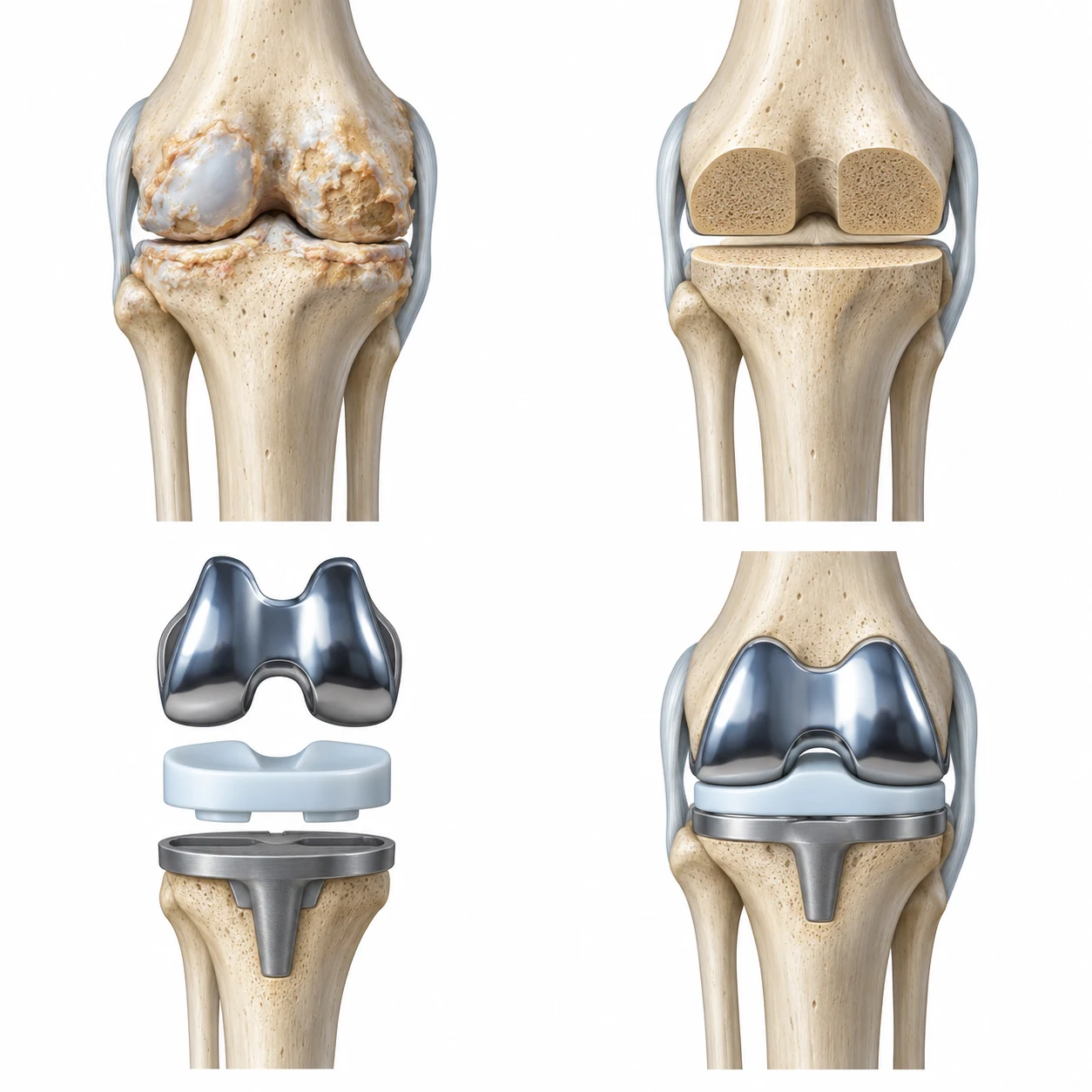
Assess the damaged areas
Joint wear and leg alignment are evaluated to plan reconstruction.
Prepare the joint surfaces
Damaged surfaces are carefully prepared while limiting disturbance to surrounding tissues.
Place the implant components
Femoral and tibial components are fitted with a wear-resistant bearing.
Check balance and stability
Leg alignment, soft-tissue balance and movement are checked before the wound is closed.
AI-assisted illustrations show a simplified surgical sequence, not actual surgery. Procedures, instruments and implants vary with each patient’s condition.
Where surgical visibility and safety allow, soft-tissue disruption is reduced to support recovery and everyday function.
Pain control, wound care and strength training help you gradually rebuild the movement needed for daily life.
WATCH & UNDERSTAND
Patient education video
Minimally invasive total knee replacement
You can read the illustrated guide above while the video is being prepared.
Explore the video library →Patient education video coming here soon.
HTO, partial or total knee replacement: how is the choice made?
| Treatment | Main approach | Assessment focus |
|---|---|---|
| HTO joint preservation | Realign the leg while preserving the native joint surfaces. | Inner-knee wear with bow-leg alignment; other compartments and activity needs are assessed. |
| Partial knee replacement | Replace one damaged compartment. | Wear is confined to one compartment and the remaining joint and ligaments are suitable. |
| Total knee replacement | Reconstruct more extensively damaged joint surfaces. | More widespread degeneration, pain or deformity affecting daily life. |
The choice depends on imaging, ligament stability, the distribution of wear and everyday needs. No single operation suits everyone.
Ongoing support through recovery
- Wound and symptom careGuidance on wound monitoring, medicines and when to contact your medical team.
- Activity matched to your progressPain control, wound care and strength training help you gradually rebuild the movement needed for daily life.
- Follow-up and your next stepsCare and training are adjusted using examination results and your everyday goals.
Questions you may have
Does minimally invasive surgery only mean a smaller incision?
It also means reducing soft-tissue disruption while ensuring accurate implant position and joint stability. Incision length is adjusted to individual needs.
What can I expect from surgery?
The aims are to reduce pain and improve mobility and daily function. Results depend on your condition, strength and participation in rehabilitation.
What risks should I understand?
Risks include infection, blood clots, persistent pain, stiffness and implant loosening. Your individual risks are assessed before surgery.
Find the treatment that fits your needs
Bring your symptoms, imaging and everyday goals to discuss with Dr. Chen.
References
This page provides general patient education. Treatment, surgery time and care arrangements are determined through individual clinical assessment.