
Knee health · JOINT HEALTH JOURNAL
HTO Knee Preservation: Realigning the Leg to Unload Arthritis
With inner-knee arthritis and a bowlegged alignment, load may remain concentrated on the worn compartment. High tibial osteotomy (HTO) changes leg alignment to transfer load toward a healthier area, offering a knee-preserving option for selected patients.
Selection starts with the pattern of arthritis
Assessment often focuses on active patients with predominantly medial arthritis and a correctable varus alignment. The other compartments, ligament stability, motion and bone quality also matter. Extensive arthritis across several compartments may make another treatment more appropriate.
Redistributing joint load
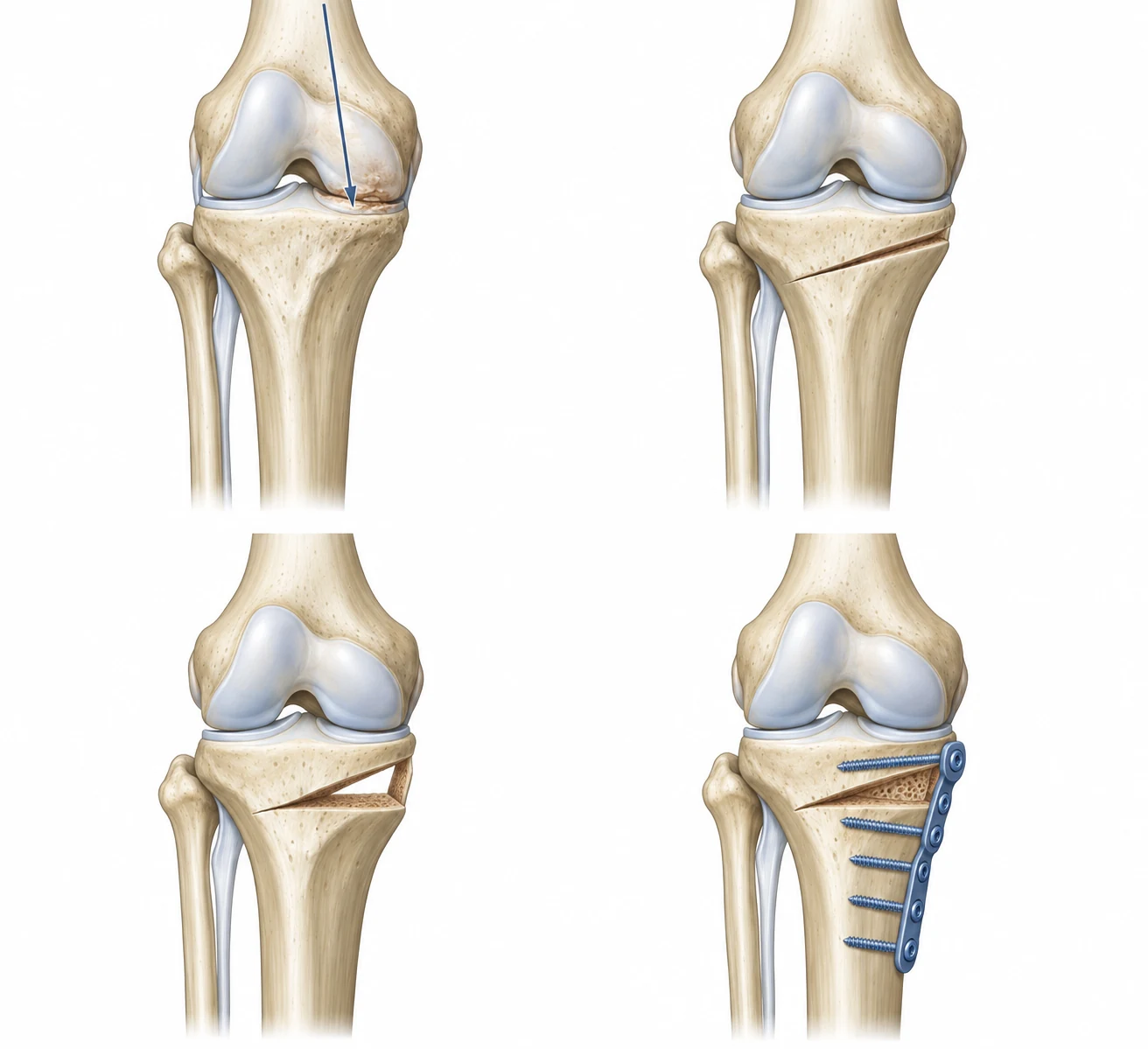
Opening-wedge osteotomy and plate fixation
A planned cut is made in the upper tibia, opened from the medial side to adjust alignment, and held with a plate and screws while bone heals. The native knee surfaces remain. Dr. Chen’s usual planning estimate is about one hour, adjusted for correction and any additional procedures; anesthesia preparation and recovery-room time are separate.
The HTO treatment pathway
Preservation comes with a healing commitment
HTO preserves the native joint and may postpone replacement. Higher-impact activity depends on bone healing, strength and reassessment. Discuss risks such as delayed healing, infection, clots, incomplete correction and plate irritation. It does not guarantee that joint replacement will never be needed.
Preservation and replacement work differently
Three questions for your appointment
- Is my arthritis mainly in the medial compartment?
- How do HTO, partial and total replacement fit my condition?
- How will healing and readiness for activity be assessed?
The aim is less pain and better function with your native knee. Dr. Chen emphasizes tissue preservation and ongoing support, adapting rehabilitation to your follow-up findings.
Medical references
General education does not replace individual assessment. Treatment is tailored to your condition and goals; diagrams illustrate concepts.