
Hip health · JOINT HEALTH JOURNAL
What Is DAA Hip Replacement? A Muscle-Sparing Approach
Direct anterior approach (DAA) hip replacement reaches the joint from the front, replacing damaged surfaces to relieve pain and support everyday movement. It uses a plane between muscles with an emphasis on soft-tissue preservation. New York’s Hospital for Special Surgery (HSS) describes anterior replacement as widely adopted in the United States; suitability remains an individual decision.
Muscle planes and capsule repair
DAA uses an interval between muscles rather than routinely detaching major muscles to gain access. Dr. Chen also emphasizes preserving capsule tissue: it is opened for access and repaired when the tissue and operative circumstances allow. Tissue preservation does not mean that no tissue is opened or that surgery is risk-free.
From muscle interval to joint
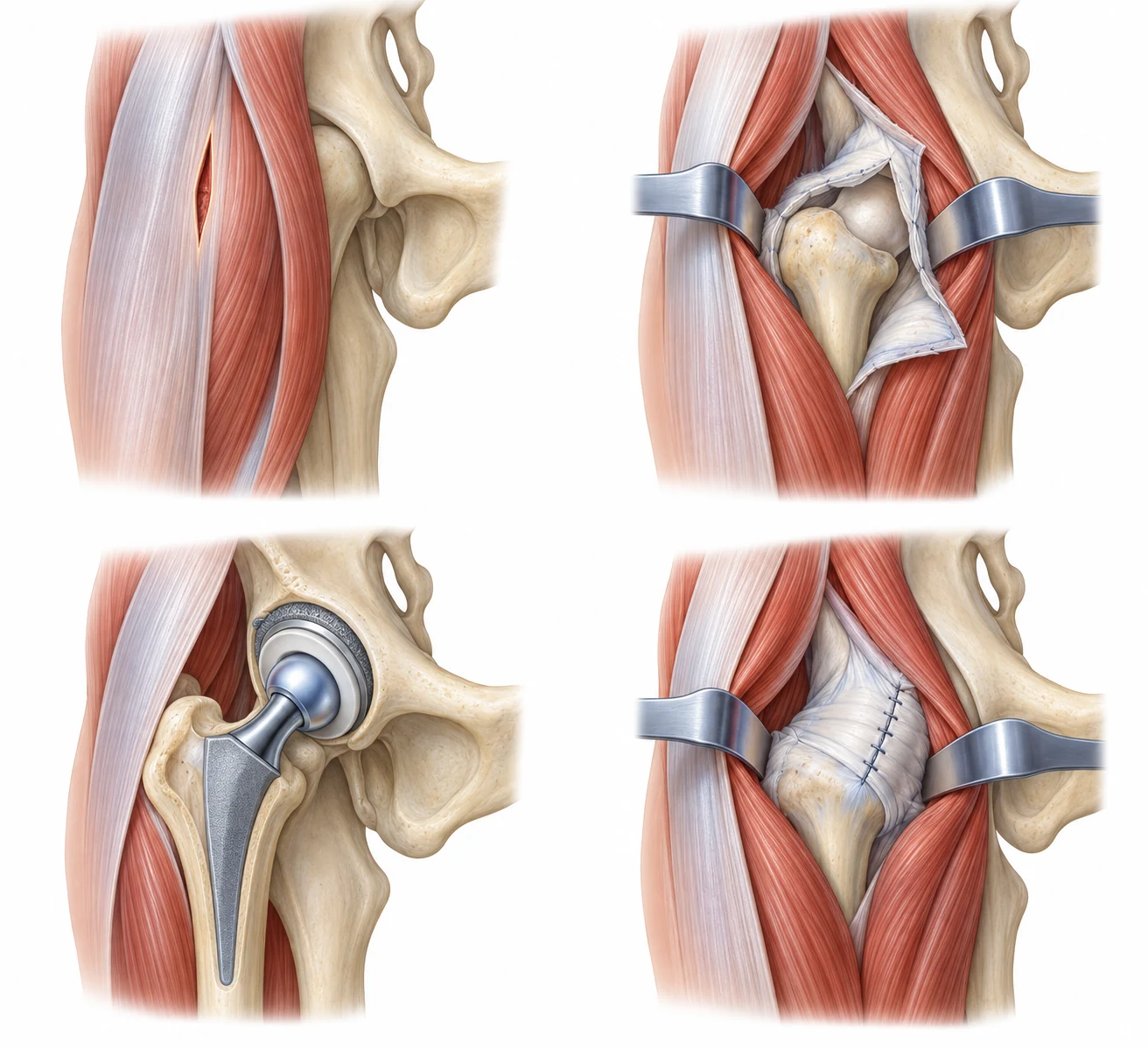
Replacement includes alignment and stability
The damaged femoral head and joint surfaces are replaced with socket and femoral components. Stability, movement and leg length are checked. Dr. Chen’s usual planning estimate is about 1.5–2 hours of surgery; complexity can change this, and anesthesia preparation and recovery-room time are separate.
Four parts of the procedure
How does it compare with other approaches?
The main differences are access direction and soft-tissue handling. DAA may offer early functional advantages for selected patients, but is not proven best for everyone over the long term. Lateral and posterior approaches remain established options. Discuss infection, dislocation and fracture, as well as possible skin-sensation changes associated with anterior access.
Choose an approach in context
Three questions for your appointment
- Is DAA appropriate for my anatomy?
- How will capsule repair and implant choice be planned?
- How will follow-up and rehabilitation be coordinated?
Care extends from tissue preservation to wound, strength and gait follow-up. Plan work, sport and travel with your team according to your individual progress.
Medical references
General education does not replace individual assessment. Treatment is tailored to your condition and goals; diagrams illustrate concepts.